

In the early 1960s, acclaimed British science fiction author Brian Aldiss unleashed one of the most bizarre and imaginative visions of Earth’s far future ever put to paper. Titled Hothouse, this novel takes readers on a journey to the last days of an utterly transformed world, where humanity has been diminished to insignificance and all-conquering nature runs rampant. It’s a lush, terrifying, and curiously beautiful look at a planet’s cycle of life and death on a grand scale.
The Baked Earth
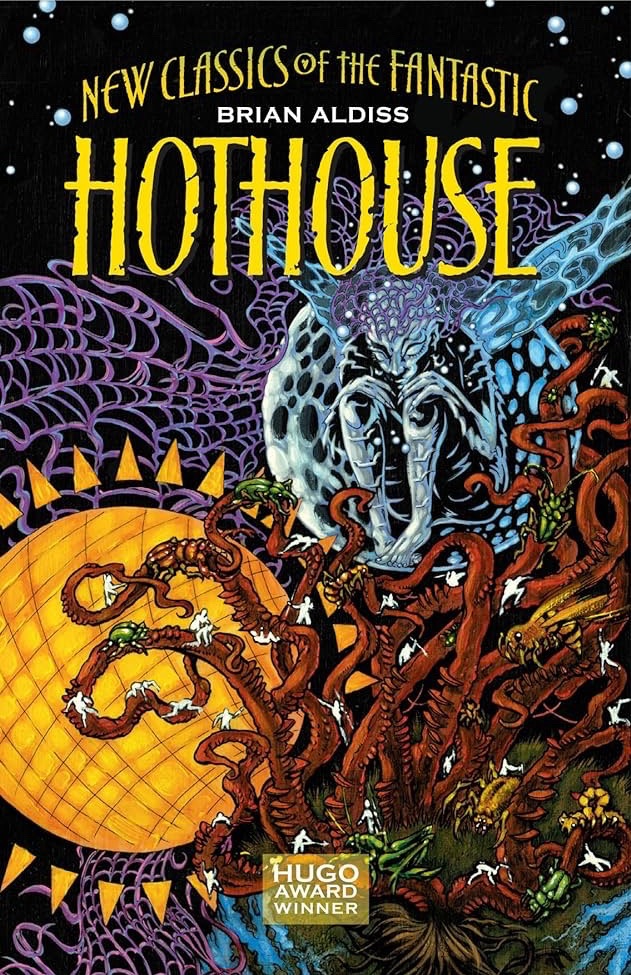
The premise of Hothouse is simple yet audacious: Due to increased solar radiation over millions of years, the Earth has become tidally locked with the sun filling half the sky like a bloated orange orb. This endless heat and humidity have caused plant life to explosively mutate and take over as the dominant life form.

A single immense banyan tree now covers the entire sunlit side of the globe in an interminable living jungle. Animal life, unable to keep pace evolutionarily, has withered away into nothingness – except for humans and insects, both now diminished to miniature scales.
Humanity has regressed into small, primitive tribes eking out meager existences within the endless tangles of branch and vine that form their entire universe. They are no more masters of the world than termites dwelling inside a backyard tree stump in our time.
Aldiss’s Inventiveness on Display
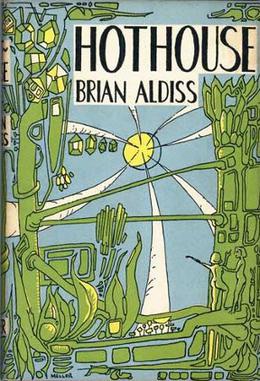
From this unsettling yet strangely whimsical setup, Hothouse weaves a surreal adventure tale dripping with lush, vivid descriptions and jaw-dropping imaginative creations. Humans may be sidelined, but Aldiss conjures up all manner of extraordinary new forms of plant and fungal life to fill the void.
We meet parasitic intelligent fungi like the “morel” that can merge with humans and effectively become them. There are slithering snake vines, harmful mold clouds, sinister laughing mushrooms, and tree stumps possessed of ethereal consciousness.

Most disturbingly, certain strains of flora have even evolved rudimentary mobility and predatory habits. Gigantic spider-like plants stalk the jungle with their long legs and snapping jaws. Single-cellular plant life has grown to swallow humans whole like something out of H.P. Lovecraft’s nightmares. Nothing is as it seems in this dreamlike world.
Gren’s Perilous Odyssey
Weaving between these wonderfully depicted inhabitants and biomes is the novel’s central plot following the human character Gren. A member of one of the nomadic forest tribes, Gren gets separated from his group during their once-in-a-lifetime pilgrimage to send elders into orbit to seed a new world.
With his fellow tribesmen scattered among the endless trunks and fronds, Gren must now navigate the omnipresent perils of this remade ecological order largely alone. Every turn brings new threats from malicious or indifferent botanical lifeforms.

After a harrowing series of vivid encounters and near-death experiences, Gren eventually has his own consciousness subsumed by an ancient parasitic morel fungus. Yet even with its encyclopedic knowledge of the planet’s biosphere now uploaded into his mind, there are greater questions that remain unanswered about the purpose of this bizarre new jungle world.
An Ecological Odyssey
While it may initially read like a straight adventure yarn akin to the old pulp tales, Hothouse ultimately emerges as something far more thought-provoking and layered. Aldiss takes readers on a grand, imaginative tour of planetary-scale ecological succession and humanity’s place within it.
The early human civilization depicted fell not due to nuclear war or atmospheric apocalypse, but simply through the inexorable, timeless march of nature itself. Like every previous dominant species in Earth’s long history, humankind simply hit an evolutionary dead end and ceded the future to more adaptable forms of life.
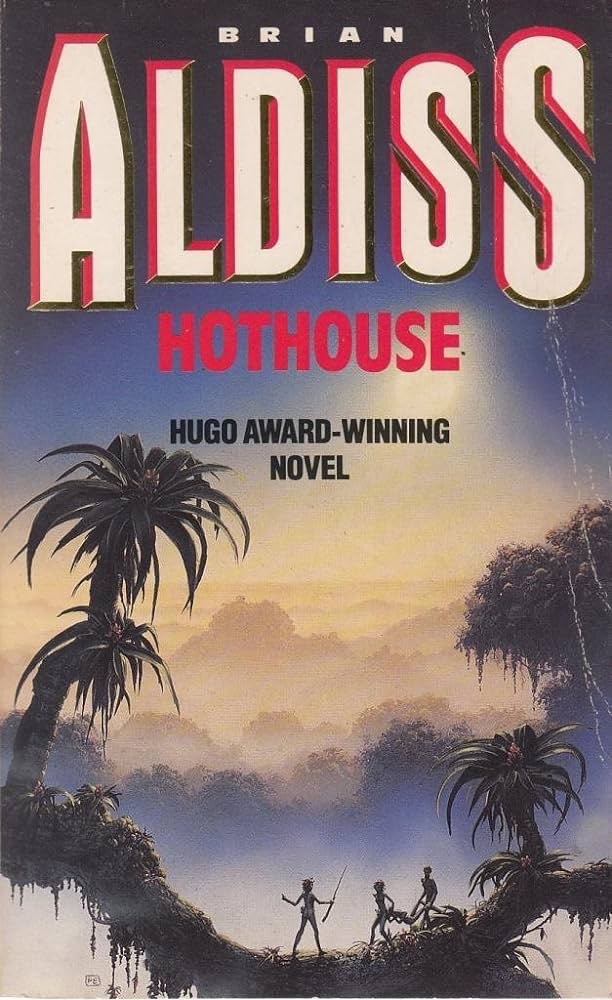
In Hothouse, Aldiss presents an awfully plausible endgame scenario for life on our world, with the human race no longer a planetary conqueror but a dwindling side note. Ancient fungi recall dim legends from lost epochs of skyscrapers and space travel like our own fairy tales, while the true inheritors go about their verdant business undisturbed.
It’s a melancholy, bittersweet portrait of nature’s inexhaustible vitality crushing the hubris of an entire species beneath an indifferent foot. No author had ever imagined so vividly what the long, long aftermath of homo sapiens’ reign might resemble in such detail before. It’s a potent lesson in the minuscule sliver of time our civilization occupies in Earth’s vast lifespan.
A Lasting Classic
While some of the specific scientific ideas like planetary spin and gravitational effects may be considered dated by modern standards, Hothouse shines as a miraculous early exemplar of the “dying Earth” subgenre. Aldiss’s singular imagination and powerful gift for gorgeous, haunting prose elevate this short novel far above a mere “what-if” thought experiment.
Readers witness firsthand entire new ecosystems taking shape before their eyes. They feel the thick, cloying humidity and smell the overpowering botanical aromas. Bizarre entities like morels, tummy-bellies, and spider underminers take on vivid personalities of their own. While humans dwindle away, other forms of being flourish and mutate as through a series of cosmic snapshots.

Longtime fans still consider Hothouse Aldiss’s magnum opus, and it’s easy to see why. Few novels have so thoroughly immersed readers in the terrifying truth of nature’s inherent indifference, while stirring a sense of childlike wonderment at its beauty. It’s an ecological odyssey to the end of human time itself on a fever-dream scale.
Upon its initial serialized release, the celebrated sci-fi editor John Carnell stated the book provided “infinite food for speculation and thought.” That sentiment still rings true many decades later. Even in our age of computer-rendered planetary visualizations, this imaginative work remains a towering, awe-inspiring achievement of literary science fiction. Hothouse endures as Brian Aldiss’s strangest, most compelling, most quintessentially sci-fi vision of life after humanity’s fall.
Discover more from Fear Planet
Subscribe to get the latest posts sent to your email.
