
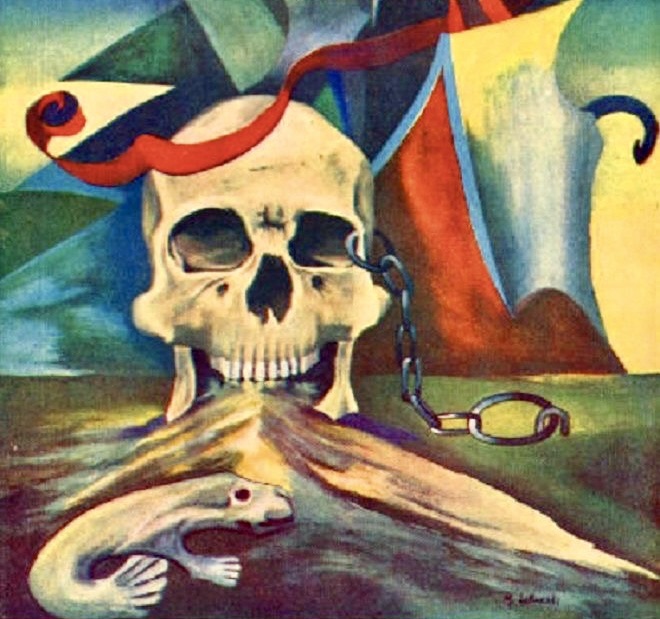
Ah, Weird Tales. Where would my love for the eerie and the unexplainable be without this legendary pulp magazine? It was without question a simmering stew of creativity, bubbling over with stories that were part science fiction, part fantasy, and a whole lot of weird. The kind of weird that sticks to your brain like peanut butter to the palate. This mag wasn’t just a publication; it was a portal. A portal that led you down a corpse-strewn rabbit hole into a Wonderland of dark and twisted fiction.

And who were the mad hatters at this tea party of the bizarre? The wizards behind the weird words that wove such compelling tales of horror, fantasy, and the supernatural? Let me introduce you to my four favorite conjurers of the dark, the wordsmiths of the warped: Robert E. Howard, Clark Ashton Smith, H.P. Lovecraft (affectionately known as HPL around these parts), and Seabury Quinn. Grab your lantern and let’s head on into the shadows to explore the minds of these literary luminaries together.
Robert E. Howard: Barbarian Bard
First up, we have Robert E. Howard, a man whose pen was as mighty as Conan’s sword. Howard had the uncanny ability to transport you to the savage lands of Hyboria, where the laws of man were secondary to the laws of survival. His stories weren’t just adventures; they were visceral experiences. Reading Howard is like riding a wild stallion bareback – exhilarating, slightly dangerous, and you might get thrown off if you’re not careful.

Howard’s Conan the Barbarian is the epitome of the antihero – a character as complex as he is muscular. Howard’s storytelling reminds me of that one uncle who’s lived a life so adventurous, you’re not sure if his stories are true or the result of too many beers. But you believe him anyway because, man, what if they are true?
Before we move on to the next pulp genius on the list, here are three of my favorite REH stories, summarized.
- “The Shadow Kingdom”: Imagine a world where serpentine shapeshifters pull the strings behind the throne, and the only thing standing between them and total domination is a muscle-bound monarch with a penchant for swordplay. In “The Shadow Kingdom,” King Kull of Valusia discovers that his court is crawling with these slinky, sinister conspirators. It’s a tale of trust and treachery where the line between friend and foe is as blurry as a lizard’s tail in a sandstorm.
- “Wolfshead”: Picture a young man with a dark secret and a hairier alter ego. “Wolfshead” introduces us to a protagonist who’s got more in common with the local wildlife than he’d like to admit. Under the glow of the full moon, he finds himself howling at the sky, sprouting fur, and craving rare steaks. This werewolf story is a hairy, scary romp through the jungle of the supernatural, where the bite is definitely worse than the bark.
- “The Horror from the Mound”: Saddle up for a spooky ride through the Wild West where cowboys and vampires collide. In “The Horror from the Mound,” a curious cowboy digs up more than he bargained for when he uncovers an ancient grave. Instead of gold or guns, he finds a fanged fiend with a thirst for blood and a serious aversion to sunlight. It’s a dusty, blood-splattered showdown that gives a whole new meaning to the term “dead man’s hand.”
All worth reading, and re-reading. Take my word for it.
Clark Ashton Smith: Sorcerer of Syntax
Clark Ashton Smith was the guy who, if Weird Tales were a high school, would be voted “Most Likely to Invoke an Ancient Deity for Fun.” Smith’s vocabulary was as expansive as the universes he created. Reading his stories is like wandering through a dark, enchanted forest; you’re mesmerized by the beauty but also slightly afraid you might get eaten by a grue.

His tales of mythic Southern Swamps, Hyperborea, and Averoigne mixed horror, fantasy, and science fiction in a cocktail so potent, you’d swear you were hallucinating after a few sips. Smith’s work is not for the faint of heart or the limited of vocabulary. He’s like that professor whose class you love and fear in equal measure because you know your brain will get a workout.
Here’s a brief and quirky tour through three of Smith’s most popular stories, each a gem of weird fiction:
- “The Vaults of Yoh-Vombis” – Imagine stumbling upon an ancient Martian city, where the architecture is as dead as the dodos but far less friendly. A group of intrepid explorers, probably regretting they didn’t just go to Mars for some space selfies, uncover more than they bargained for. Inside these eerie vaults, they find not the expected Martian relics or cosmic knick-knacks, but a horror that’s been waiting patiently for a fresh batch of Earthling intruders. It’s a classic “curiosity killed the cat” scenario, but with more tentacles and cosmic dread[4].
- “The Mother of Toads” – Picture this: a quaint French village with a witch that would give any toad a run for its money in a beauty contest. Our protagonist, a young and somewhat naive chap, finds himself under the spell of this witch, proving that love (or lust) is truly blind, or at least severely myopic. What follows is a tale of potions, grotesque seductions, and a lesson in “be careful what you wish for,” especially if it involves amphibian-like witches offering you dubious brews in the dead of night[3].
- “The Monster of the Prophecy” – This story takes us to the bustling streets of New York City, where a failed poet contemplates the ultimate escape from his woes. Enter a mysterious stranger who offers not a listening ear, but a trip across the cosmos. It’s a tale of interstellar intrigue, alien encounters, and the realization that maybe, just maybe, Earth’s oddities are quaint compared to the universe’s vast menu of bizarre. It’s a cosmic rollercoaster ride that makes you ponder the real monsters of prophecy: our own expectations
H.P. Lovecraft: Prophet of Cosmic Doom
Ah, HPL, where do I even start? Lovecraft didn’t just write stories; he created a mythology. His tales of cosmic horror, where the greatest threat isn’t the monster under the bed but the vast, indifferent universe, have left an indelible mark on the genre. Lovecraft teaches us that ignorance isn’t just bliss; it’s a downright survival strategy.

Reading Lovecraft is like being the last person awake at a sleepover, and you decide to conjure spirits because, why not? His universe is one where humans are not at the top of the food chain, and frankly, not even close to it. His stories are a humbling reminder that, in the grand scheme of things, we’re about as significant as a speck of dust on Cthulhu’s tentacle.
Three classic tales lie summarized below. As a fan of the Weird, you owe it to yourself to consume them.
1. “The Call of Cthulhu”: Imagine a colossal, tentacle-faced grump from the depths of the sea, who’s also a cosmic entity with a fan club of cultists. This big guy, Cthulhu, is napping underwater in the lost city of R’lyeh, and he’s got the whole world dreaming about him. When he’s not snoozing, he’s inspiring madness and mayhem. It’s like if your worst nightmare had a nightmare, and that nightmare decided to throw a party in your head.
2. “The Dunwich Horror”: In the backwater town of Dunwich, something’s brewing, and it’s not just the moonshine. Wilbur Whateley is a strange fellow who grows at an alarming rate and has a thing for the occult. He’s got a monstrous secret sibling who’s invisible and likes to stomp around the countryside. When Wilbur tries to borrow an overdue library book (the notorious Necronomicon), things go south, and it’s up to a trio of scholars to save the day with some good ol’ fashioned academia and a dash of magic.
3. “The Shadow over Innsmouth”: Take a trip to Innsmouth, a fishy town with a peculiar smell and even stranger inhabitants. Our protagonist goes sightseeing, only to find that the locals are a bit too into their seafood—if you catch my drift. Turns out, there’s a deep-sea social exchange program going on, with humans and aquatic creatures from the deep called Deep Ones swapping lives and DNA. It’s a tale of identity crisis with a splash of marine biology gone wild.
Seabury Quinn: Maestro of Mystery
While not as widely recognized today as some of his contemporaries, Quinn was a titan of the twilight in his time, especially known for his stories of Jules de Grandin, a detective of the supernatural, which were a staple of Weird Tales.

Quinn’s tales were the kind that made you want to sleep with a night light, but in the classiest way possible. His stories were like a four-course meal at a haunted mansion: deliciously inviting but with a lingering sense of dread. Jules de Grandin was like if Sherlock Holmes decided to take on vampires instead of Victorian villains, with a dash of French flair for good measure.
Reading Quinn is akin to attending the most eccentric and eerie masquerade ball. Each story invites you into a world where the veil between the living and the dead is as thin as gossamer, and sometimes it tears. Quinn had this knack for blending the gothic with the detective genre, creating a hybrid that was as intriguing as it was unsettling.
Here are three examples of his writing that is essential reading:
- The Occult Oddities of Jules de Grandin: In the bustling streets of Harrisonville, New Jersey, there’s more than just the humdrum of everyday life. Enter Jules de Grandin, the sharp-witted, sword-cane-wielding occult detective with a French flair. He’s the man you call when ghosts decide to throw a house party or when vampires fancy a midnight snack. With nearly three hundred tales under his belt, de Grandin’s escapades are a cocktail of Sherlock Holmes meets Van Helsing, shaken with a twist of le fantastique!
- The Devil’s Bride – A Love Story with a Hellish Twist: Imagine a romance novel penned by a demon, and you’ve got “The Devil’s Bride.” It’s a tale where love potions are replaced with cursed amulets, and the suitor is more likely to turn into a beast than ride one. This novel-length story takes you on a wild ride through a love story that’s less about fluttering hearts and more about fleeing from satanic cults. It’s a wedding where “till death do us part” has never been more literal.
- Roads – Santa Claus’s Secret Origin: Forget the jolly old man in red; Quinn’s “Roads” gives us a Santa Claus with a backstory darker than a lump of coal. This isn’t your typical Christmas tale; it’s a journey through ancient legends where Saint Nicholas earns his stripes battling evil and traversing mystical paths. It’s a holiday story that’s more Grimm’s Fairy Tales than Hallmark Channel, proving that even the most cheerful of figures has shadows lurking in his past.
Quinn’s work is a bit like finding an old, beautifully bound book in a dark corner of an antique shop. It’s a treasure, filled with tales of darkness and mystery that captivate you from the first page. You’re not sure what spells or specters you’re summoning by cracking it open, but you can’t resist the allure.

The Wrap-Up
Weird Tales served as the primordial soup from which my fascination with the strange and the supernatural evolved. These authors, with their boundless imagination and flair for the macabre, have influenced not just me but generations of writers and creators who followed. They were the pioneers on the frontier of the fantastic, mapping out territories that others would explore long after they were gone.
Their stories are a reminder that the world is far stranger and more wonderful than we could possibly imagine. In their tales, they’ve left us a legacy of wonder and warning: that sometimes, the monsters are real, but so is the magic.
So, here’s to the weird word wizards of Weird Tales – may their stories continue to inspire awe, curiosity, and a healthy dose of fear in the hearts of those brave enough to read them.

Discover more from Fear Planet
Subscribe to get the latest posts sent to your email.

Comments are closed.