

Few works tower as monumentally as Frank Herbert’s “Dune.” I’ve traversed countless fictional universes over the years, but I keep finding myself drawn back to the shifting sands of Arrakis, where spice flows and destinies unfold in ways that continue to resonate nearly six decades after its publication. Today, I want to take you Fear Planet denizens on a journey through this masterpiece – not just as a critic examining a novel, but as a fellow traveler who has walked the desert paths alongside Paul Atreides and felt the rumble of sandworms beneath my feet (if only in my dreams).
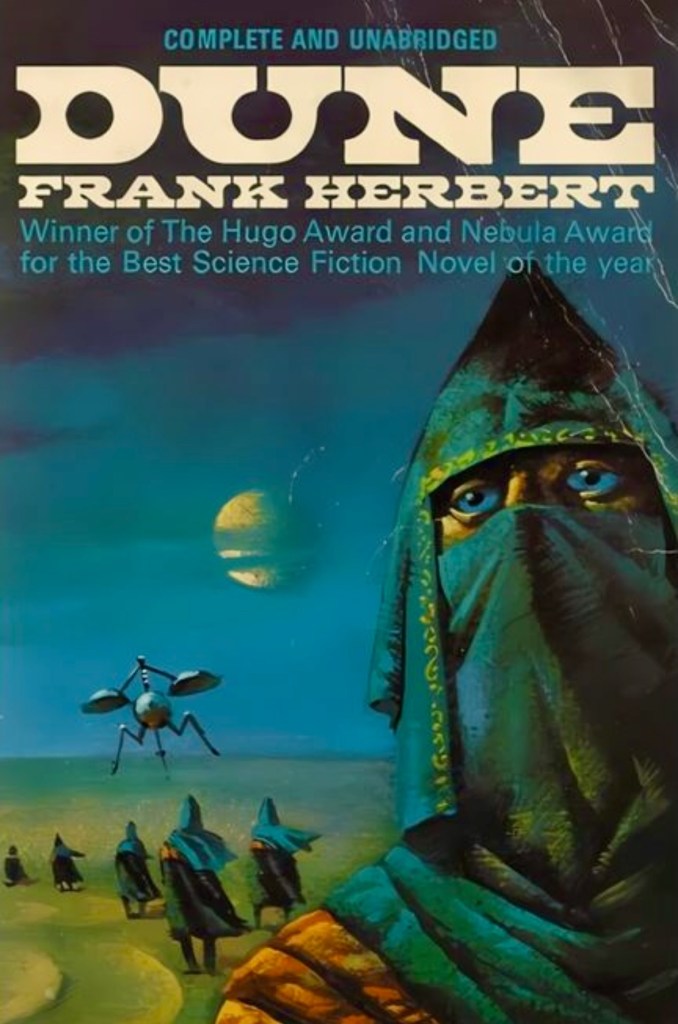
Why Dune Still Matters in Today’s Sci-Fi Landscape
When I first cracked open “Dune” as a teenager back in the 1980s, I couldn’t possibly comprehend how deeply this 1965 novel would embed itself into both the science fiction genre and our broader cultural consciousness. Reading it now, with adult eyes and a deeper appreciation for its complexities, I’m struck by how Herbert created something that feels simultaneously ancient and futuristic – a story that reads as if it were translated from some forgotten historical text about events thousands of years in our future.
What makes “Dune” exceptional isn’t just its longevity, but its prescience. Long before climate change dominated headlines, Herbert gave us a masterclass in ecological science fiction. Before “Game of Thrones” made political intrigue fashionable, “Dune” showed us houses great and small maneuvering for power across the stars. And in an era when science fiction often celebrated technological progress uncritically, Herbert dared to question whether humanity’s path forward might lie not in machines but in the development of human potential itself.

A Note on the Screen Adaptations of DUNE
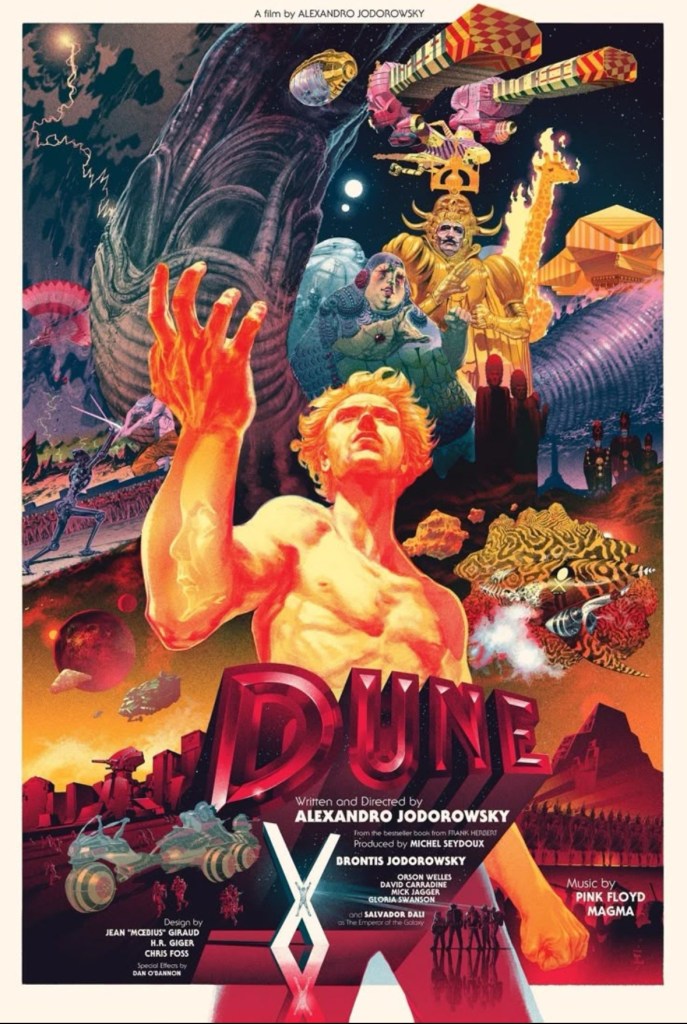
For many people, their first encounter with the Desert Planet of Arrakis comes not through Herbert’s prose but through one of its screen adaptations. The journey of bringing “Dune” to visual life has been almost as epic and fraught with challenges as Paul Atreides’ own path to becoming Muad’Dib (see Jodorowsky’s DUNE).
The earliest attempt that actually made it to completion was David Lynch’s 1984 “Dune” movie – a fascinating failure that somehow manages to be both slavishly devoted to certain elements of Herbert’s vision while completely missing the mark on others. Lynch’s baroque visual style created some genuinely memorable imagery, but the compressed storyline and awkward exposition (including abundant voiceovers) left many viewers confused and critics unimpressed. Still, this adaptation has developed a cult following over the decades, with some fans appreciating its weird, dreamlike quality and Kyle MacLachlan’s earnest performance as Paul.

After Lynch’s divisive take and an admirable but budget-constrained Sci-Fi Channel miniseries in 2000, it seemed the Chronicles of Dune might be unadaptable – until Denis Villeneuve stepped into the spice-laden sands. His two-part adaptation (2021/2023) has finally given Herbert’s masterpiece the cinematic treatment it deserves. With Timothée Chalamet embodying the complex journey of Paul Atreides, Villeneuve’s version manages to capture both the vast scope of the interstellar power struggle and the intimate psychological development at the heart of the story.
What makes Villeneuve’s adaptation particularly successful is its patience – recognizing that “Dune” cannot be rushed. By splitting the novel and allowing its themes and world to breathe, his films avoid the compressed storytelling that doomed previous attempts. The Sand Worms in particular – those massive creatures central to Arrakis’ ecology – finally receive the awe-inspiring visual treatment they deserve, rendered with a scale and gravitas that matches Herbert’s description.
It’s worth noting the reciprocal relationship between “Dune” and cinema. While today’s viewers might see elements of “Star Wars” in “Dune,” the influence actually flows in the opposite direction – Lucas borrowed heavily from Herbert’s work. The desert planet, the voice powers, the chosen one narrative, and the quasi-religious orders all appeared in “Dune” before “Star Wars” existed. Seeing Villeneuve’s adaptation helps clarify this legacy, reminding us how profoundly Herbert’s vision shaped science fiction in all media.

For someone approaching Herbert’s universe for the first time, the recent films offer an accessible entry point, though they capture only a fraction of the novel’s philosophical depth. The devoted fan of science fiction will find rewards in all the adaptations – each reflects its era’s approach to the genre and demonstrates the challenges of translating Herbert’s intricate world to screen. But none replaces the experience of the novel itself, where the internal lives of characters and the full complexity of Herbert’s vision can be fully expressed.
The Vast Canvas of Arrakis: Setting the Stage
“Dune” unfolds in a feudal interstellar society approximately 20,000 years in our future, where noble houses control planetary fiefs under the watchful eye of Emperor Shaddam IV Corrino. Technology exists, but computers and “thinking machines” are notably absent – banned after the Butlerian Jihad, a devastating war against artificial intelligence that reshaped human development. Instead, specialized humans like the Mentats (human computers) and Guild Navigators (mutated humans who can fold space for interstellar travel) fulfill these functions.

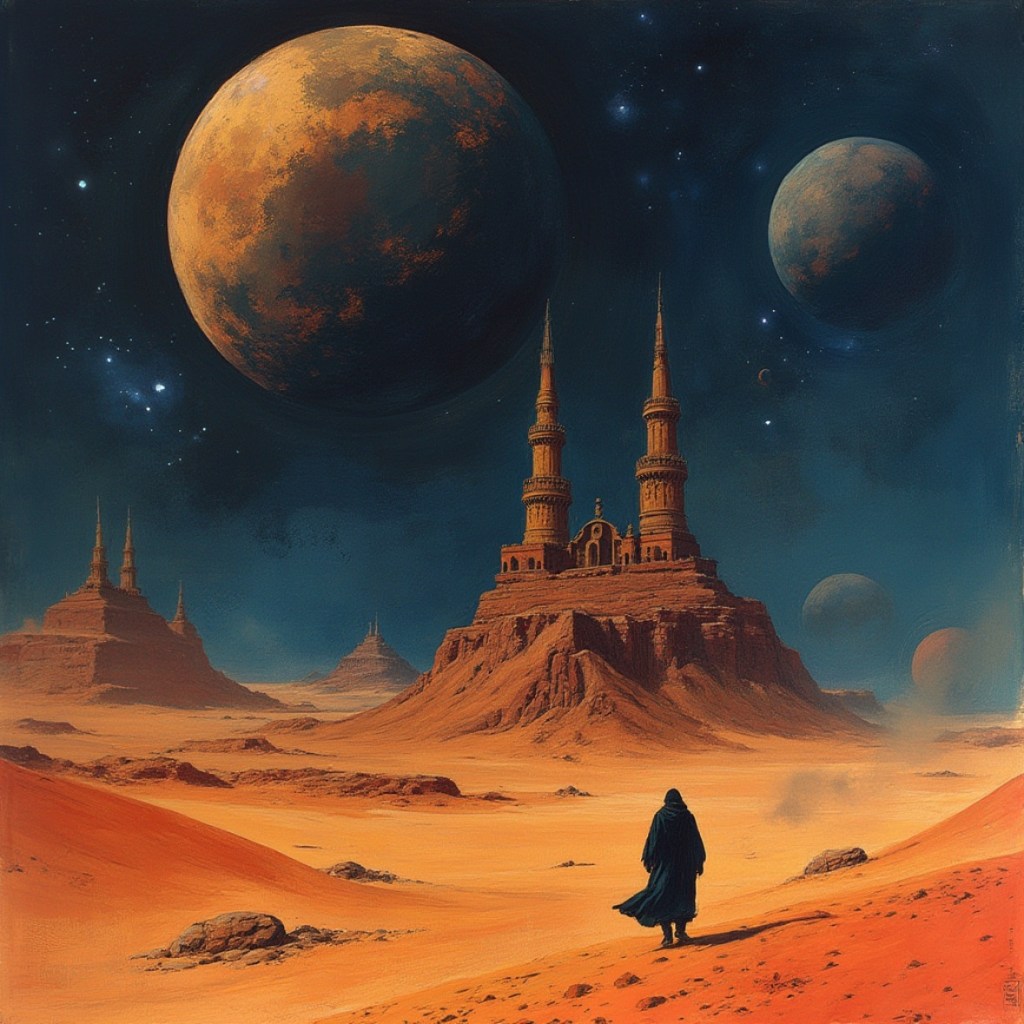
At the heart of this universe lies Arrakis – Dune – a desert planet of unforgiving harshness and untold wealth. Its surface, scoured by relentless winds and baked by twin suns, harbors the most precious substance in the universe: the spice melange. This cinnamon-scented substance extends life, enhances mental abilities, and most crucially, enables space travel through prescient navigation. Without it, the interstellar empire would collapse. And Arrakis is the only place in the universe where it can be found.
This scarcity creates the central tension that drives everything in Herbert’s universe. Whoever controls Arrakis controls the spice. Whoever controls the spice wields immeasurable power.
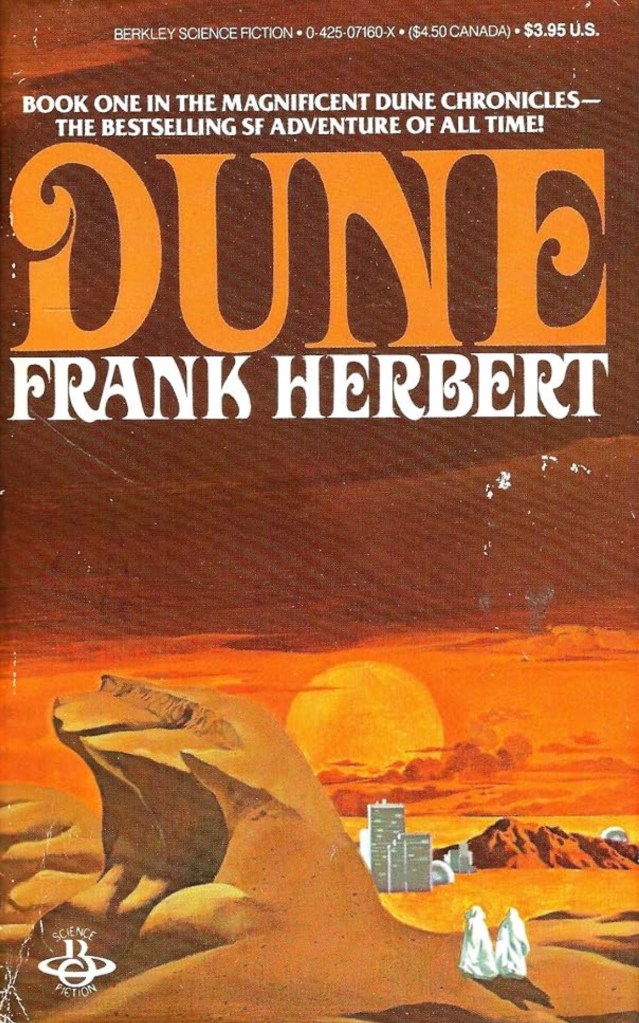
A Synopsis: The Rise of Muad’Dib
The story opens with House Atreides preparing to take control of Arrakis, replacing their bitter rivals, House Harkonnen, at the Emperor’s command. Duke Leto Atreides, a man of uncommon honor in a dishonorable universe, knows this assignment is likely a trap but cannot refuse an imperial decree.
His son, Paul, stands at a crucial developmental crossroads. Trained in the ways of the Bene Gesserit by his mother Lady Jessica (herself a member of this secretive sisterhood), schooled in warfare by weapons master Gurney Halleck and swordmaster Duncan Idaho, and educated in strategy and logic by Mentat Thufir Hawat, Paul is no ordinary fifteen-year-old. When the Bene Gesserit Reverend Mother Gaius Helen Mohiam visits the Atreides homeworld of Caladan to test Paul with the gom jabbar – a deadly test of humanity versus animal instinct – we glimpse the first hints that Paul may be more than he appears.

Upon arriving on Arrakis, the Atreides begin making inroads with the planet’s native Fremen population while establishing their spice mining operations. However, their governance is short-lived. Baron Vladimir Harkonnen, aided secretly by the Emperor’s elite Sardaukar troops disguised as Harkonnens, launches a devastating attack. A trusted Atreides physician, Dr. Wellington Yueh, betrays the family by disabling their defensive shields, though he attempts to give Duke Leto a chance for revenge by replacing one of his teeth with a poison gas capsule to use against the Baron.
The assault leaves Duke Leto dead, though he manages to kill the Baron’s Mentat, Piter de Vries, with the tooth. Paul and a pregnant Lady Jessica escape into the deep desert, where they eventually encounter the Fremen. Paul, now recognized by many Fremen as the prophesied Lisan al-Gaib or “Voice from the Outer World,” takes the Fremen name Muad’Dib and begins rising within their society.
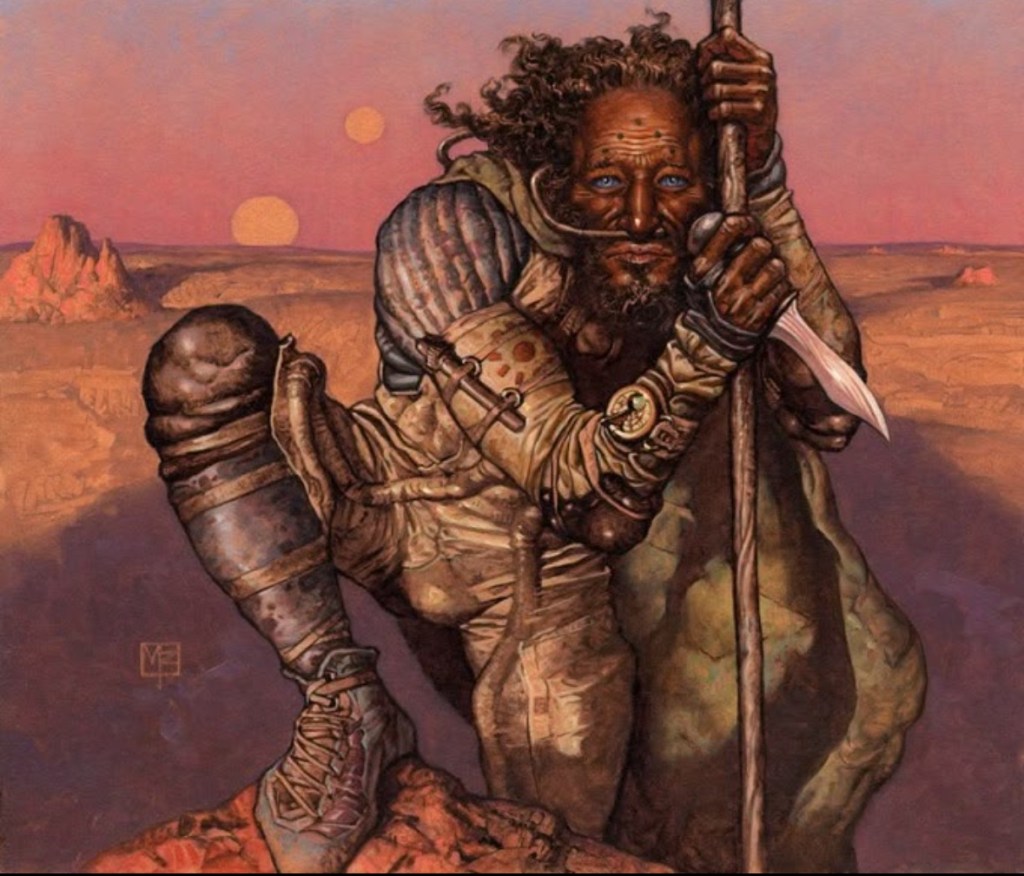
Among the Fremen, Paul’s latent abilities blossom. By consuming massive quantities of spice in a ritual called the Water of Life, Paul achieves a transformative awareness that grants him prescient visions. Meanwhile, Jessica undergoes her own transformation, becoming a Fremen Reverend Mother and giving birth to Alia, Paul’s sister, who is born with full consciousness and ancestral memories due to Jessica’s spice consumption during pregnancy.
Paul teaches the Fremen his family’s fighting techniques, transforming them into an even more formidable fighting force. He falls in love with Chani, daughter of planetologist Liet-Kynes, and they have a son. After years of guerrilla warfare against the Harkonnens, Paul leads the Fremen in a final massive assault during a planet-wide storm that disables the energy shields of the Harkonnen and Imperial forces.

Victorious, Paul confronts the Emperor, Baron Harkonnen (who is revealed to be Jessica’s father), and representatives from the Spacing Guild, Bene Gesserit, and other power brokers of the empire. By threatening to destroy the spice – something he could do by introducing water to the desert ecosystem – Paul forces the Emperor to abdicate and agrees to marry his daughter Princess Irulan, though Chani will remain his true wife.
The novel concludes with Paul triumphant yet trapped by his own legend. He has become the Emperor and religious leader of a fanatical army that he knows will spread violence across the universe in his name – a jihad he foresaw but could not prevent. His prescience has become both power and prison.
The Characters of Dune: A Desert Tapestry

“Dune” features one of the most memorable casts in science fiction literature. Here’s a deeper look at the key players:
- Paul Atreides/Muad’Dib – Our protagonist begins as a privileged but talented young nobleman and evolves into something far more complex. What makes Paul fascinating is his internal struggle between his humanity and his growing messianic status. Unlike typical heroes who simply gain powers and save the day, Paul’s journey is marked by painful psychological development and philosophical questioning. His prescience becomes a trap – showing him futures he wants to avoid but cannot. I find his trajectory from potential chosen one to reluctant messiah particularly compelling because it subverts the typical power fantasy arc. His triumph is simultaneously his tragedy.
- Lady Jessica – Paul’s mother and a Bene Gesserit who chose to bear a son rather than a daughter against her orders. Jessica embodies the tension between duty and love, between organizational loyalty and personal attachment. Her training makes her formidable, but her choices make her human. Her evolution from ducal concubine to Fremen Reverend Mother represents one of the most significant character arcs in the novel.
- Duke Leto Atreides – Though his presence in the book is relatively brief, Leto’s influence extends throughout the narrative. His commitment to honor and ethical governance stands in stark contrast to the Machiavellian politics of the Imperium. His love for his family and sense of responsibility to his people make his inevitable downfall all the more poignant.
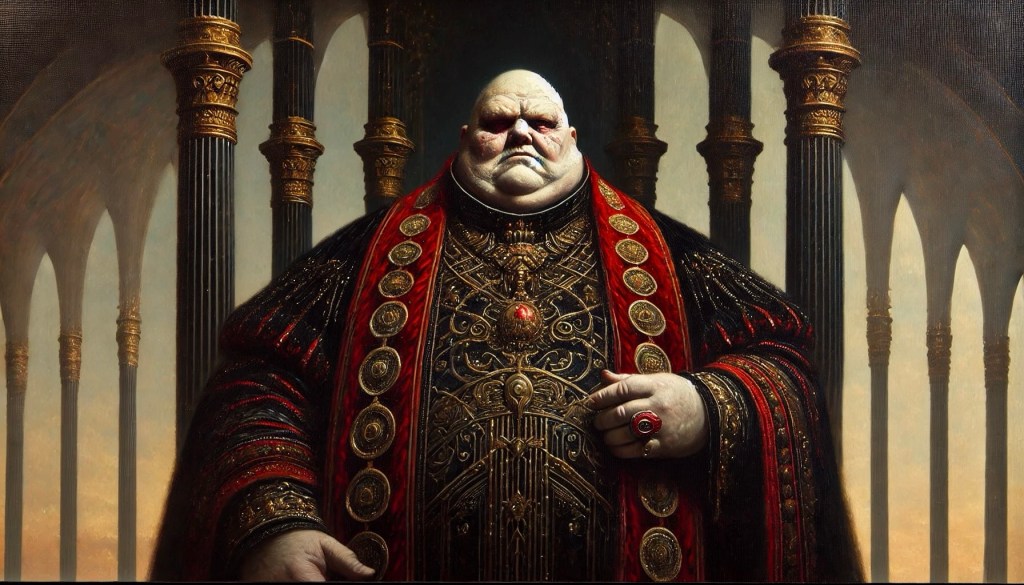
- Baron Vladimir Harkonnen – A villain of operatic proportions, the Baron combines brilliant strategic thinking with sadistic cruelty and unchecked appetites. Herbert avoids making him a mere caricature by giving him genuine intelligence and cunning. His familial connection to Jessica adds unexpected complexity to his character.
- Thufir Hawat – The Atreides Mentat master of assassins represents the human alternative to computers. His computational mind and absolute loyalty make him a fascinating character caught between worlds after the fall of House Atreides.
- Gurney Halleck – Weapons master to House Atreides and a warrior-poet with a scarred face (courtesy of the Harkonnens), Gurney provides both martial training and cultural education to Paul. His blend of brutality and beauty makes him one of the most human characters in the novel.
- Duncan Idaho – The swordmaster of House Atreides and one of the first to recognize the military potential of the Fremen. His legendary fighting skills and absolute loyalty establish him as the epitome of the noble warrior.
- Dr. Wellington Yueh – The tragic traitor whose conditioning was supposed to make betrayal impossible. Yueh’s character explores how even the strongest psychological barriers can be broken by the right leverage – in his case, the torture of his beloved wife.
- Stilgar – The Fremen Naib (leader) whose initial suspicion of the Atreides gives way to fierce loyalty to Paul. Through Stilgar, we see both the proud tradition of Fremen culture and its capacity for change.
- Chani – Daughter of Liet-Kynes and Paul’s Fremen concubine, Chani is far more than a love interest. Her desert wisdom and fighting prowess make her a partner to Paul rather than merely his companion.
- Liet-Kynes – The planetary ecologist straddling two worlds as both imperial servant and secret leader of the Fremen. His dream of transforming Arrakis from desert to paradise represents the novel’s ecological heart.
- Reverend Mother Gaius Helen Mohiam – The Bene Gesserit Truthsayer who tests Paul and reveals much about the sisterhood’s breeding program. Her pragmatic manipulation embodies the Bene Gesserit approach to power.
- Feyd-Rautha Harkonnen – The Baron’s nephew and planned successor, groomed as the antithesis to Paul. His physical prowess and cunning make him a worthy final adversary.
- Princess Irulan – Daughter of the Padishah Emperor and Paul’s political wife. While her role in the first book is limited, her historical writings form the epigraphs that begin each chapter, adding scholarly context to the events.
The Politics of Dune: A Game of Cosmic Chess
What has always fascinated me about “Dune” is how Herbert creates a political system that feels simultaneously alien and deeply familiar. The feudal structure of the Imperium – with its Great Houses, CHOAM corporation, Spacing Guild, and Bene Gesserit sisterhood – creates a balance of power reminiscent of medieval Europe but with interstellar stakes.
The Landsraad Council represents the collective power of the noble houses, preventing any single family (including the Emperor’s House Corrino) from becoming too dominant. CHOAM (Combined Honors Merchants Association) controls economic matters across the empire, with directorship shares held by the Emperor and the Great Houses. The Spacing Guild monopolizes interstellar travel, while the Bene Gesserit manipulate bloodlines and politics from the shadows.

This system creates multiple vectors of power – military, economic, religious, and genetic – that intertwine in a complex dance. What makes Herbert’s political worldbuilding exceptional is how he shows these forces not as abstract concepts but as lived realities affecting characters at every level, from emperors to desert dwellers.
The political genius of “Dune” lies in how Herbert shows that despite the advanced setting, the fundamental nature of power remains consistent across millennia – it flows to those who control essential resources, can deploy violence effectively, and can shape narratives and beliefs.
The Spice: More Than Just a Resource
The spice melange deserves discussion as practically a character in its own right. Far more than a convenient plot device, spice represents the ultimate extractive resource – irreplaceable, location-specific, and society-altering. Its properties extend human life, enable space travel through prescient navigation, enhance mental abilities, and create addictive dependency.

What makes spice truly brilliant as a worldbuilding element is how Herbert uses it to connect every aspect of his universe. It links ecology (produced by sandworm life cycles), economics (the foundation of imperial wealth), politics (whoever controls Arrakis controls the spice), religion (central to Fremen ritual), and human evolution (enabling mental expansion and prescience).
The spice cycle – from the microscopic sandplankton to the enormous sandworms – creates a closed ecological system that mirrors our own planet’s interconnected biosphere. Herbert was writing ecological science fiction before the term existed, showing how human intervention in natural systems creates cascading consequences.
Most impressively, Herbert uses spice as both literal substance and potent metaphor. It stands in for oil, water, and other limited resources over which humans have always waged war. Its addictive properties and withdrawal symptoms reflect dependency relationships between colonizers and colonized. Its consciousness-expanding aspects connect to the countercultural interests of the 1960s when the novel was written.

Worlds Beyond Arrakis: The Dune Universe
While Arrakis dominates our attention, Herbert sketches a broader universe of remarkable diversity:
- Caladan – The ocean planet home of House Atreides, with its moderate climate and abundant water representing the antithesis of Arrakis. Its sustainable management under the Atreides reflects their philosophical approach to governance.
- Giedi Prime – The industrial homeworld of House Harkonnen, polluted and harsh, mirroring the brutal efficiency and disregard for humanity that characterizes Baron Harkonnen’s rule.
- Kaitain – The capital planet and home of the Imperial Court, a world of opulence and intrigue where the Emperor maintains his formal residence.
- Salusa Secundus – The Emperor’s prison planet, with harsh conditions that forge the feared Sardaukar troops. Its existence demonstrates how extreme environments shape human development – a theme Herbert explores more fully with the Fremen.
- Ix – Though barely mentioned in the first novel, this technological planet produces the empire’s most advanced devices, maintaining humanity’s technological advancement despite the prohibition on thinking machines.
- Tleilax – Home of the Tleilaxu, masters of biological engineering who create twisted products like the twisted Mentats used by the Harkonnens.

The Unique Strengths of Dune
Having read “Dune” multiple times across different phases of my life, I find new layers with each revisit. Herbert’s greatest achievements include:
- Ecological Awareness – Long before environmental concerns became mainstream, Herbert created a novel fundamentally about the relationship between humans and their environment. The detailed ecology of Arrakis, from its spice cycle to water conservation methods, represents science fiction at its most thoughtful.
- Religious and Mythological Depth – The Bene Gesserit’s Missionaria Protectiva, which plants protective legends among various populations, shows Herbert’s understanding of how religions evolve and function. Paul’s journey follows archetypal hero patterns while simultaneously subverting them, creating a unique meditation on messianic figures.
- Psychological Complexity – Rather than focusing on technological speculation, Herbert turned his attention to human potential and psychological development. The mental training of the Bene Gesserit, the computational abilities of Mentats, and Paul’s expanding consciousness explore how humans might evolve without relying on artificial intelligence.
- Cultural Anthropology – The Fremen, with their water-preservation rituals, survival technologies, and social structures, represent one of literature’s most fully realized fictional cultures. Herbert shows how their environment shapes every aspect of their existence, from language to religion to combat techniques.
- Political Realism – By portraying politics as a multidimensional chess game with economic, military, religious, and dynastic dimensions, Herbert created a political landscape that feels authentic despite its futuristic setting.

Where Dune Falls Short (The 4-Star Rating Explained)
Despite my admiration, I can’t ignore certain shortcomings that prevent “Dune” from achieving absolute perfection:
- Prose Style – Frank Herbert’s writing style can be dense and occasionally clunky. While this suits the epic nature of his tale, it lacks the poetic quality of contemporaries like Ursula K. Le Guin or the manic energy of Philip K. Dick. Some passages feel needlessly convoluted, particularly when exploring characters’ interior thoughts.
- Limited Female Agency – Though Jessica and Chani are compelling characters with significant abilities, the overarching structure of the Dune universe still places women primarily in supporting roles. The Bene Gesserit, despite their powers, ultimately serve a breeding program aimed at producing a male superbeing. This reflects the novel’s era but remains a limitation.
- Pacing Issues – The middle section of the book, as Paul and Jessica adapt to Fremen life, occasionally drags. Herbert’s commitment to worldbuilding sometimes comes at the expense of narrative momentum.
- Underdeveloped Secondary Characters – While the primary cast receives substantial development, some potentially fascinating secondary characters remain relatively flat. The Emperor, for instance, appears primarily as a political function rather than a fully realized person.
- Dated Elements – Certain aspects of Herbert’s future vision betray the novel’s 1960s origins. The emphasis on eugenics and selective breeding programs, while treated critically, receives more serious consideration than modern readers might find comfortable.

Dune Endures
“Dune” endures not just as an entertaining adventure but as a work of profound cultural significance. Its exploration of resource scarcity, religious manipulation, and ecological interdependence speaks directly to contemporary concerns. Its warning about the dangers of charismatic leaders and the violence that can emerge from religious fervor remains disturbingly relevant.
Most importantly, “Dune” demonstrated that science fiction could engage with complex philosophical, ecological, and political questions without sacrificing narrative excitement. It expanded what the genre could accomplish and influenced countless works that followed.
When I consider what makes “Dune” worthy of four stars rather than five, I think of it as the difference between a masterpiece with visible brushstrokes and one of flawless execution. The ambition and vision of Herbert’s work remain unmatched, even when his technical execution occasionally falters.

Coda: A Desert Bloom
Reading “Dune” is like watching a flower bloom in the desert – unexpected, complex, and beautiful precisely because of the harsh conditions that shaped it. Herbert created not just a story but an entire universe with its own internal logic, history, and mythology.
For anyone who hasn’t experienced it, I enthusiastically recommend “Dune” as essential reading – not just for science fiction fans but for anyone interested in how literature can explore the human condition through speculative frameworks. For those who have already walked the sands of Arrakis, I invite you to return and discover, as I have, new layers of meaning with each journey.
The spice may only exist in Herbert’s imagination, but the insights his desert planet offers us about power, ecology, religion, and human potential are very real indeed. And that’s why, despite its imperfections, “Dune” remains one of science fiction’s towering achievements – a literary landmark as massive and awe-inspiring as the sandworms that patrol its unforgettable landscapes.
Final Rating
*Thanks for reading, Fear Planet denizens! If you want to revisit, save, highlight, and recall this article, we recommend you try out READWISE, our favorite reading management and knowledge retention app. All readers of Fear Planet automatically get a 60-day free trial.
This post was blasted into the social media stratosphere by HopperHQ, the best social media manager out there.
*This post contains affiliate links. Purchasing through them will help support Fear Planet at no extra cost to our readers. For more information, read our affiliate policy.
Discover more from Fear Planet
Subscribe to get the latest posts sent to your email.
