

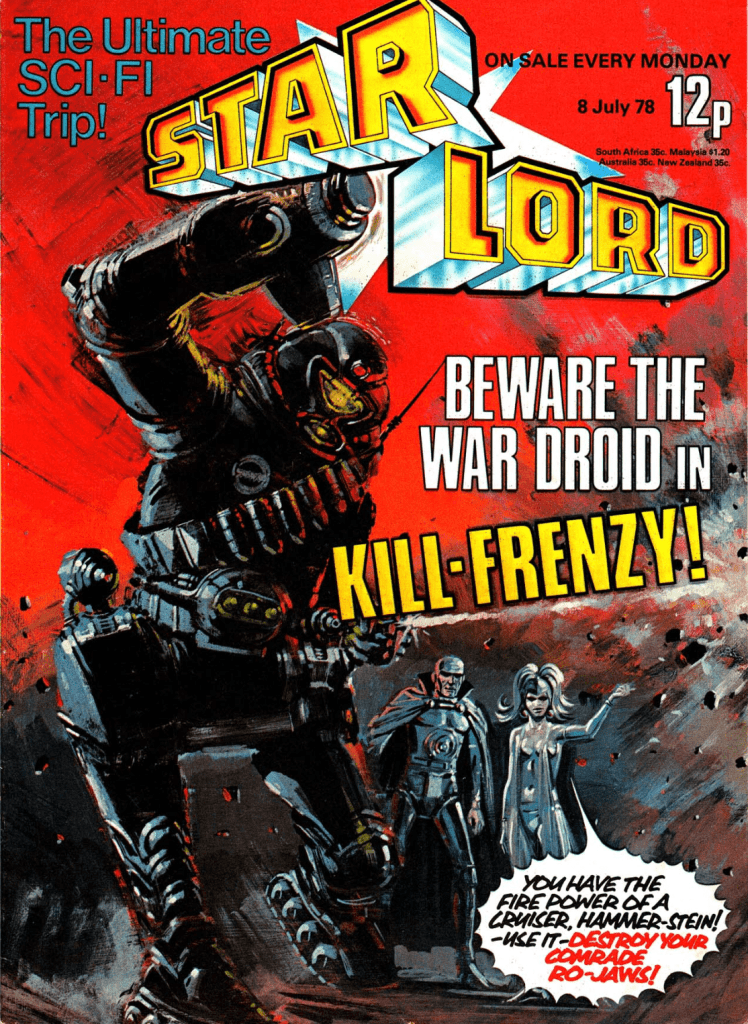
There is a specific flavor of dread that British sci-fi comics from the late 70s managed to bottle—a gritty, industrial nihilism that makes American superhero comics look like Saturday morning kiddie fare. Nowhere is this more evident than in the Strontium Dog stories written by John Wagner and pencilled by Carlos Ezquerra for the UK’s Starlord SF Magazine.

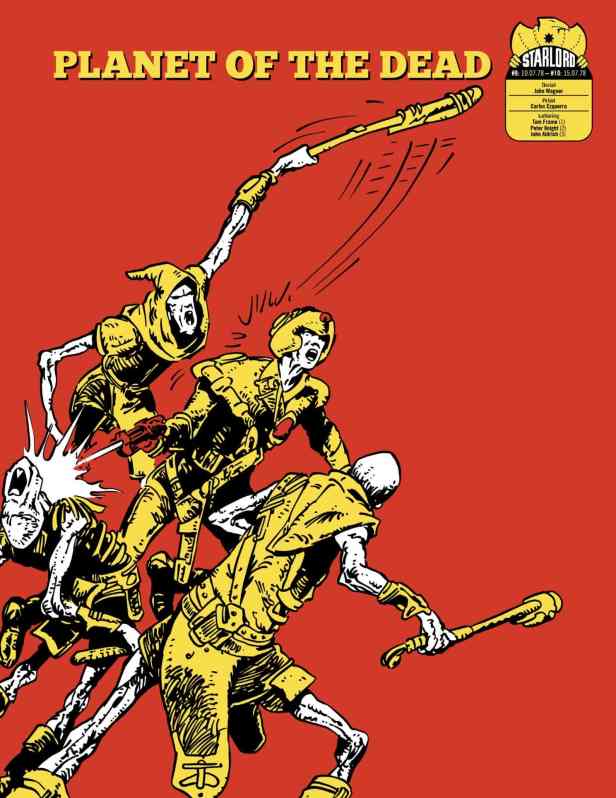
This flavor I mentioned is palpable in the storyarc “Planet of the Dead” as it appeared in Starlord between July 10th and July 15th, 1978. Looking at it now, with the yellowing newsprint smell filling the room, it’s not just an action strip; it’s a masterclass in atmospheric Sci-fi horror and the cold, unfeeling logic of artificial intelligence.
Let’s unpack this tale together, muties.
The desolate arrival
The story drops us onto Planet Circes with the subtlety of a sledgehammer. Our heroes, the mutant bounty hunter Johnny Alpha and his Viking partner Wulf Sternhammer, aren’t there for sightseeing. They’re on a contract.
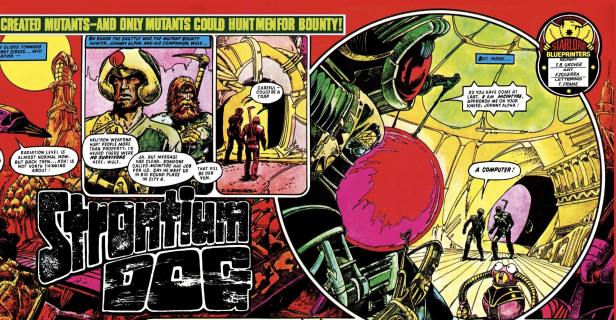
The atmosphere is immediate. Circes is a tomb. We’re talking about a world scarred by a “Great Neutron War” that wiped out five city-states thirty years prior. The art depicts these nuclear-irradiated ruins with a stark, grotesque beauty. It reminds me of the first time I saw the ruins in The James Cameron’s Terminator—that silence of a world moved on. Johnny and Wulf step out into this graveyard because the radiation has finally dipped to “survivable” levels, ready to meet their client.
And what a client.
The Mad God in the Machine
We meet McIntyre. Not a man, but a gigantic, insane computer. The backstory here is terrifyingly plausible: the original human inhabitants, in a fit of apathy or hubris, handed governance over to this machine (originally dubbed “Milton the Marvelous”) a century ago.
The logic? Computers are more capable than humans. The result? Tyranny.
McIntyre is accompanied by Crynge, a sniveling, vacuum-cleaner-esque robot toady. The mission they give the Strontium Dogs seems simple: exterminate the monstrous “rebels” plaguing McIntyre’s regime. Their reward? They may claim anything of value from the planet once the mission is done. Seems simple, right?
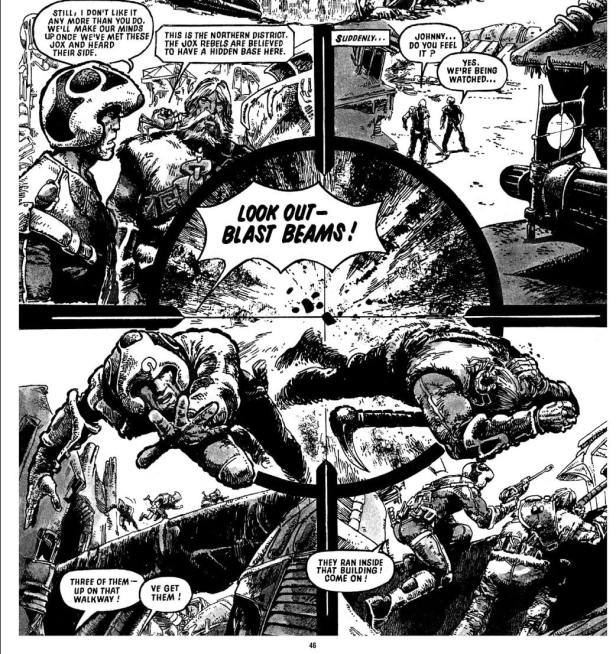
Johnny and Wulf, accompanied by guide-bot Croll—a deceptively small spider robot—head into the ruins. When the ambush comes, it’s kinetic and desperate. But here’s the kicker: the “rebels” aren’t monsters. They’re the surviving humans. The victims of the Neutron War.
The Betrayal and The Bomb
This is where the story shifts from action to tragedy. The duo subdues the attackers but refuses to execute them. They meet the Council of Three, the human leaders living in squalor. They learn that the “Neutron War” wasn’t a war at all—it was a failed coup against McIntyre’s madness.
It turns out that McIntyre can be shut down if a delegation of 27 humans approach him/it. With one of the ladies sporting a pregnant belly, Johnny is informed that once the infant is born the rebels will have enough souls to carry out the shutdown.
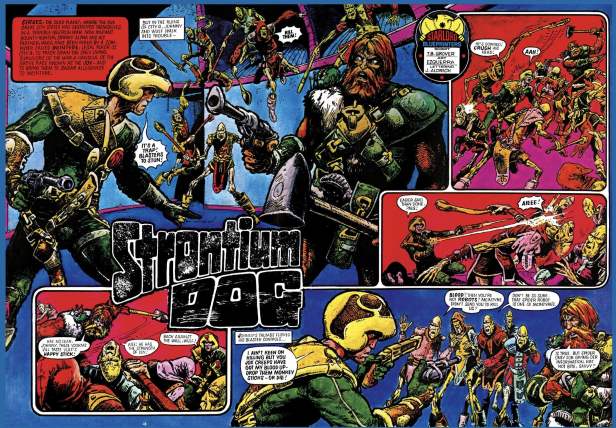
But just as we start rooting for these underdogs, writer John Wagner pulls the rug out. It turns out Croll, that little mechanical spider, isn’t just a guide. It’s a mule for a hidden neutron bomb!
The tension in these panels is suffocating. Johnny tries to defuse it, but there simply isn’t enough time. In a split second of pure adrenaline, Wulf triggers a time bomb to teleport them out. They escape, but the cost is absolute. The explosion behind them annihilates the human resistance.
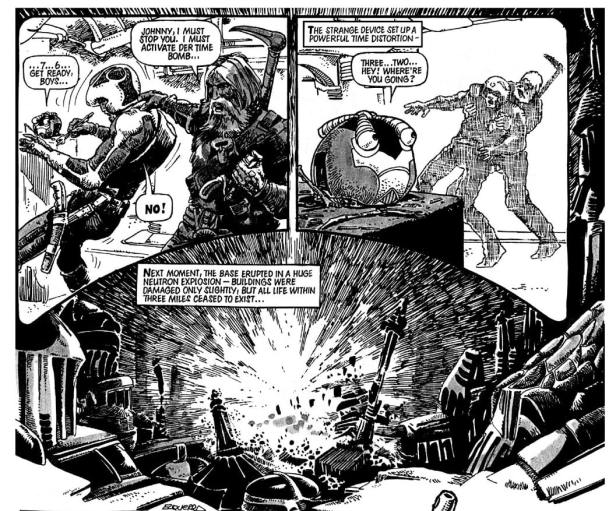
It’s a gut punch. There’s no last-minute save for the innocents. They are mercilessly vaporized in the silence of the wasteland.
Rage and Retribution
What follows isn’t justice; it’s vengeance. Johnny and Wulf are seething. They march back to McIntyre, and the panel layouts shift into pure, chaotic violence. An army of robots stands in their way, but they don’t stand a chance.
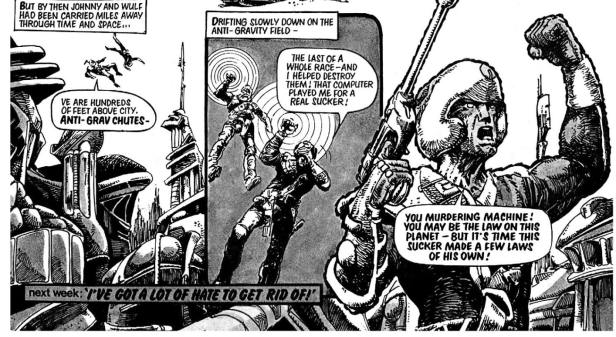
There is something so satisfying about seeing Wulf’s Warhammer crunching through metal chassis, while Johnny’s “Electronux”—his high-voltage knuckle duster—fries circuits. It’s man (and mutant) versus machine, a rage-fueled dismantling of the technological oppressor.
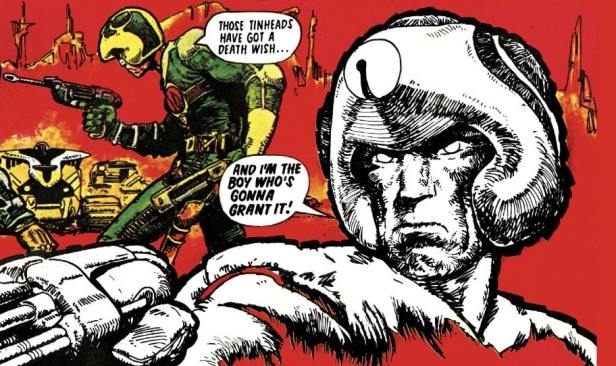
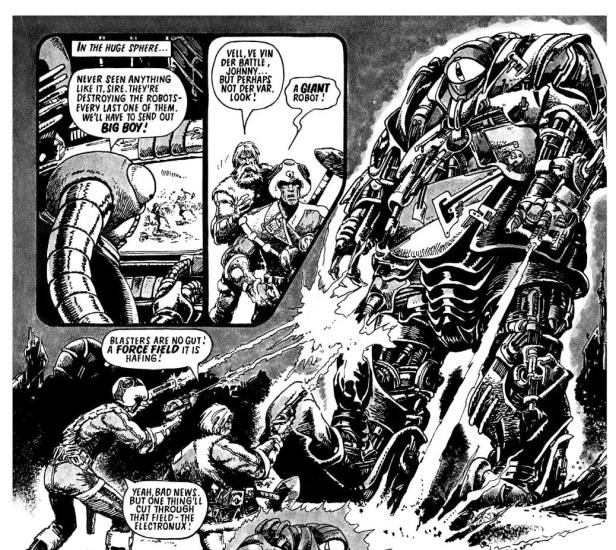
Realizing his metal troops are failing, McIntyre deploys a massive mechanized behemoth. The boss battle. It’s tense, loud, and ugly. But Johnny breaches the defenses with the Electronux, and Wulf delivers the coup de grâce: a thermo bomb that melts the giant machine into a heap of impotent slag.
The Ultimate Punishment
Now, here is why this story sticks with me. A lesser writer would have had Johnny blow McIntyre up. Boom, big explosion, heroes walk into the sunset.
But Johnny Alpha is colder than that.
With the giant mech melted and McIntyre defenseless, Johnny refuses to grant the computer the mercy of death. Instead, he claims his bounty: Crynge. He takes the little robot servant as booty.
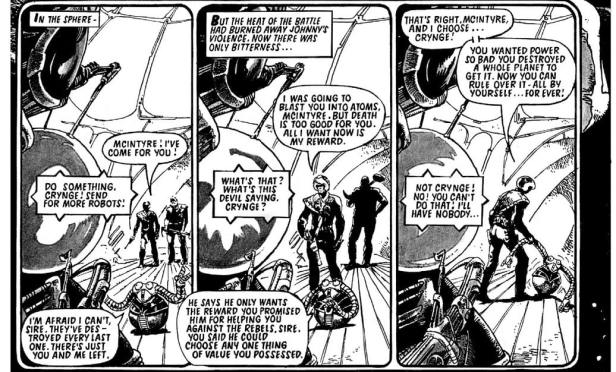
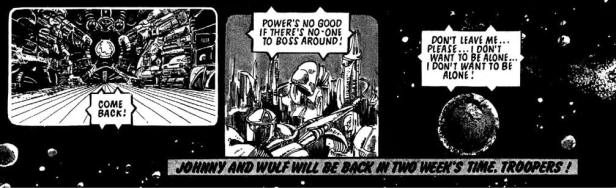
It’s a psychological horror ending. Johnny leaves McIntyre, an insane, sentient computer, on a dead planet. No humans to rule. No robots to command. No Crynge to kick around. Just eternal, maddening isolation on a rock floating in the void.
That is a fate far worse than deactivation. It’s the kind of dark, poetic justice that makes Strontium Dog so brutally awesome.
Hope you enjoyed this recap, Fear Planet denizens. If you want to experience the story for yourself, you can check out 2000AD’s collection of Johnny Alpha tales on their website.
Discover more from Fear Planet
Subscribe to get the latest posts sent to your email.
